
Last Updated:
July 24, 2026
If you've noticed a low, sprawling plant with tiny purple flowers pushing into your lawn right as the grass starts to green up, there's a good chance you're dealing with henbit (Lamium amplexicaule).
Homeowners are often caught off guard because henbit doesn't look like much at first. But give it a few weeks of favorable weather, and this broadleaf weed can cover bare or thinning patches of lawn before you've even had your first mow of the season. Keep reading to learn more about identifying and controlling this weed.

Henbit is part of the mint family, and like most weeds worth worrying about, it's got timing on its side, sprouting in the cool months when your turf is at its weakest and least able to compete. However, if you know how to spot some of the key identifiers of this lawn invader early in its life cycle, controlling it becomes much easier.
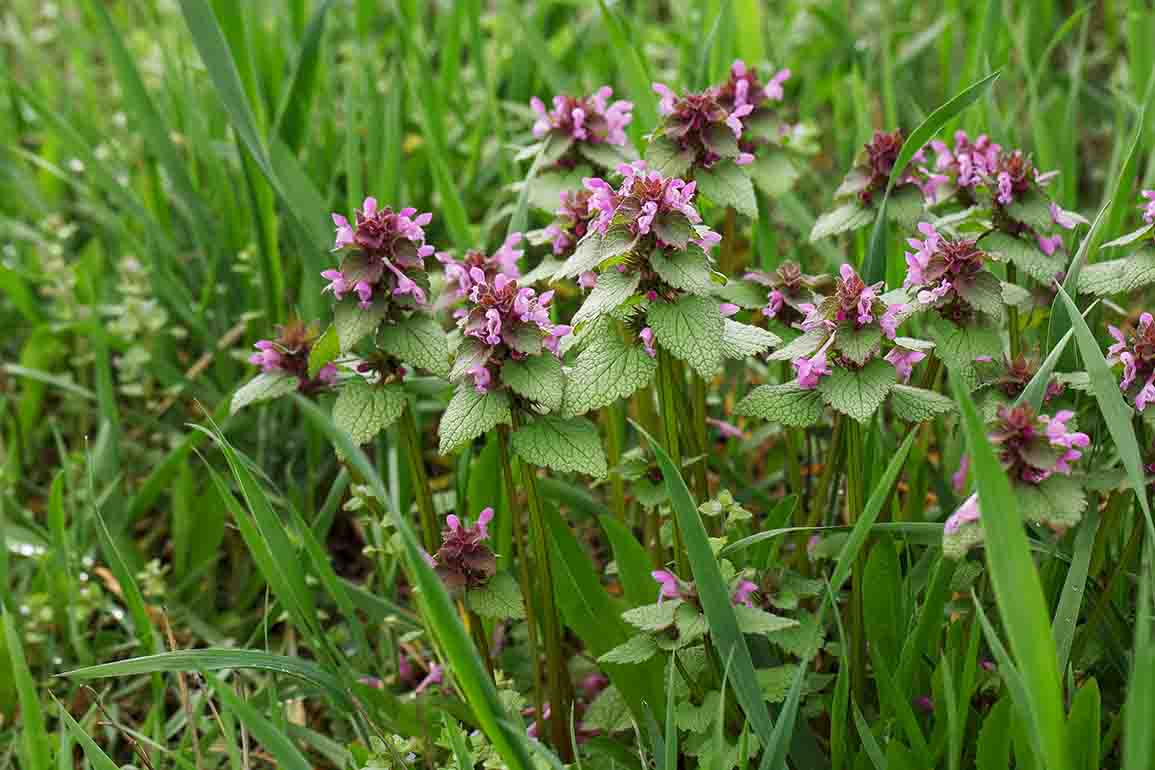
These two weeds are frequently mixed up, and it's easy to see why: same family, same growing season, similar flowers. The giveaway is in the leaves. Purple deadnettle (pictured above) has leaves that sit on short stalks and come to more of a point, often turning a deeper purple toward the top of the plant.
Henbit's leaves skip the stalk entirely, wrap around the stem, stay rounder, and generally hold onto more green. A close look at leaf shape and attachment will tell you which one you're up against.
Henbit's secret weapon is timing: it germinates and grows before most turfgrass has fully woken up for the season. Its roots are shallow and fibrous with a small taproot, just enough to snatch water and nutrients before your grass gets the chance.
Thin, compacted, or stressed lawns are especially vulnerable, giving henbit the opening it needs to form dense mats that choke out healthy turf and slow your lawn's spring recovery.
The good news is that henbit is shallow-rooted and annual, which means it's very beatable with the right combination of tactics. Catching henbit early, ideally in fall before it has a chance to establish, makes all the difference.
If it's already spreading through your yard, a combined approach of cultural care and targeted herbicide will get things back under control. Healthy Lawn’s team is ready to help build a plan suited to your lawn's specific situation to control weeds all season long!
Q: Is henbit actually harmful, or just unsightly?
A: Mostly it's a cosmetic and competitive problem. It doesn't damage grass directly, but it competes aggressively for water, nutrients, and light, especially in thin or weak turf, which can slow your lawn's spring recovery.
Q: Can I just ignore henbit and let it die off on its own?
A: You could, since it naturally dies back by late spring, but doing nothing lets it drop massive amounts of seed first, which sets you up for a bigger infestation the following year.
Q: What's the best time of year to treat henbit?
A: Early fall is ideal for pre-emergent applications, since that's before seeds germinate. If it's already growing, late winter to early spring is the window for post-emergent control, before it flowers and seeds.
Q: Will regular grass fertilizer alone keep henbit away?
A: Fertilizing helps by thickening your turf so there's less bare soil for henbit to colonize, but it won't eliminate an existing patch on its own. Pair it with mowing, pulling, or herbicide for real control.
Q: Are pre-emergent herbicides safe to use if I'm overseeding my lawn?
A: Generally, pre-emergents that stop weed seeds from germinating will also stop grass seed from germinating, so timing matters a lot. Talk to a lawn care professional or read product labels closely before combining the two.
Q: How can I tell if what I'm pulling is henbit and not just clover or another weed?
A: Check for the square stem (a mint-family signature), rounded leaves that clasp directly onto the stem with no stalk, and small tubular purple-pink flowers. Clover, by contrast, has round-lobed leaves in groups of three and lacks the square stem entirely.

Local lawn care services from a team that cares.